
Root Cause Analysis: How to Easily Transform Your Needs Assessments


Is your CME content scratching the surface or truly addressing the core issues in healthcare practice?
As a CME professional, you're constantly striving to create educational interventions that make a real difference. But sometimes, despite your best efforts, the impact falls short of expectations. Root cause analysis (RCA) could be the missing piece in your needs assessment toolkit, helping you uncover the true sources of performance gaps and design more effective CME programs.
By listening to this episode, you'll discover:
- How to apply RCA techniques to enhance your needs assessments and identify the root causes of practice gaps
- Step-by-step guidance and practical tools for conducting RCA
- Real-world examples of how RCA can lead to measurable improvements in healthcare outcomes
Tune in now to unlock the power of root cause analysis and revolutionize your approach to CME program development.
Resources
Agency for Healthcare Research and Quality (AHRQ). Root Cause Analysis.
Institute for Healthcare Improvement. Improving Root Cause Analyses and Actions to Prevent Harm.
Singh G et al. Root Cause Analysis and Medical Error Prevention. StatPearls.
Driesen B et al. Root Cause Analysis Using the Prevention and Recovery Information System for Monitoring and Analysis Method in Healthcare Facilities: A Systematic Literature Review. J Patient Saf. 2022;18(4):342-350
This podcast uses the following third-party services for analysis:
Podtrac - https://analytics.podtrac.com/privacy-policy-gdrp
Next Steps
➡️ Find out exactly where to focus next in your CME writing career. Take the free assessment.
➡️ Join AI Practice Lab: A 4-week practice lab to work hands-on with Núria Negrão PhD. Build a documented, repeatable AI workflow for research, drafting, and quality control.
📰 Want more tips and tools on CME content strategy? Subscribe to Write Medicine Insider.
🎙️ Know someone who would love this episode? Share the podcast
🎧 CME Writer Bootcamp: A complimentary private podcast on how to break into CME/CE writing
🎧 Write Medicine Mentor – Get behind-the-scenes insights and templates to deepen your CME writing practice.
📣 Want to get your message to an engaged audience of medical writers and CME professionals? Advertise with us.
Introduction to CME and Root Cause Analysis
As a CME professional, you're constantly striving to create educational interventions that make a real difference. But sometimes, despite your best efforts, the impact falls short of expectations. Root cause analysis could be the missing piece in your needs assessment toolkit, helping you uncover the true sources of practice and performance gaps, and helping you transform your needs assessments from surface level 📍 to system changing.
Hello CME Warriors, this is Alex Housen and you're tuned in to Write Medicine, the podcast that helps you craft high quality continuing medical education content that actually makes a difference. Lately, clients and CME writers have been asking me about root cause analysis. What is it? And how is this different from a needs assessment?
So today we're going to dig deep, and I mean pretty deep, into a tool that can revolutionize your needs assessments. Root cause analysis.
Understanding Root Cause Analysis
Let's start with the basics. Root cause analysis is a systematic process for identifying the underlying causes of a problem or a gap in performance or practice, rather than simply addressing the symptoms.
It's a powerful tool for getting to the heart of an issue and developing really targeted solutions. In fact, root cause analysis is like being a medical Sherlock Holmes. Instead of just treating the symptoms we're going for, we're looking for the underlying cause of the problem. This is really the difference between giving a patient a painkiller and figuring out why they're in pain in the first place.
In the context of CME, root cause analysis can be a really valuable tool for conducting a needs assessment to identify knowledge gaps, skill gaps, or areas for improvement among health professionals. Maybe you're thinking, wait a minute, isn't root cause analysis really the same as a needs assessment?
After all, when we conduct a needs assessment, we're usually looking for clinical practice or performance gaps. Sort of. I think about root cause analysis this way. In our field, root cause analysis is about finding the main problem, the root problem, causing a clinical practice or performance gap. We see the gap, now we really want to figure out what's causing that gap.
So with root cause analysis, we are really digging deeper. We ask why, repeatedly, until we get to the root of the problem. So for instance, When we see diagnostic delays in a given disease area, it's tempting to see diagnostic delay as the gap in practice and to leave our assessment there. But if we dig deeper, we might also see that procedural issues like scheduling delays, communication errors, or patchy results follow up are actually the root cause for delays in diagnosis.
I think of root cause analysis as a structured analytic tool to apply to your needs assessment process, to identify the root causes of gaps you see from your literature analysis. Survey data and lived experience interviews, and that can really help you design even more targeted educational interventions to address those root causes of clinical practice and performance gaps.
And you can also apply root cause analysis to analyze broader systemic issues within healthcare organizations, like communication breakdowns, inadequate policies or procedures, or ineffective teamwork and collaboration, by identifying the root causes of these issues, CME providers can design educational programs that address Interprofessional communication, leadership, or team based care competencies.
And if you have discerned challenges in interprofessional collaboration in a given disease state or clinical setting, a root cause analysis can help you identify root causes like siloed curricula, lack of opportunities for interprofessional interactions, or plain old communication barriers between disciplines.
Benefits of Root Cause Analysis in CME
Using root cause analysis as part of your needs assessment methodology, offers several key benefits. First, root cause analysis helps you identify the true sources of practice and performance gaps, allowing you to address the core issues rather than just the surface level symptoms.
Second, root cause analysis enables you to develop targeted interventions that are much more likely to be effective in addressing specific problems. Third, root cause analysis promotes a culture of continuous improvement by encouraging that deeper understanding of the factors that contribute to practice and performance gaps.
And fourth, root cause analysis can lead to more effective and efficient use of CME resources by ensuring that interventions are focused on the most critical issues. Now, You're probably all itching to know how do we do root cause analysis? What's the magic? Well, don't worry. I've got a step by step guide that's easier to follow than your grandmother's chocolate chip cookie recipe.
Write CME Roadmap
Before we dive into the steps of conducting a root cause analysis, I want to take a quick moment to tell you about a resource that could be a game changer for many of you out there. If you're new to the world of CME or feeling a bit lost in this complex field, I've got just the thing for you.
My book, Write CME Roadmap, How to Thrive in CME with No Experience, No Network, and No Clue, is designed to be your guide through the sometimes confusing landscape of continuing medical education. Whether you're just starting out or you're looking to level up your CME game, this book provides practical strategies.
Insider tips and a clear path to success in the world of CME. It's a resource I wish I had when I was starting out, and it pairs perfectly with the kind of in depth strategies we discuss on this podcast.
The book is available from October the 31st, and you'll be able to find it on my website. www. alexhausen. com. Now, back to our root cause 📍 analysis discussion.
Step-by-Step Guide to Root Cause Analysis
Step one. Define the problem. Start by clearly stating the gap in knowledge, skills or performance that you want to address. Be as specific as possible to ensure that your root cause analysis is focused and relevant. So you've identified the gap, you're starting there. Step two, collect data.
You're really channeling your inner scientist here. Gather information from a variety of sources to help you understand the problem and its potential causes. This might include surveys, interviews with interested parties, performance metrics, and a review of relevant literature. Step 3. Identify Contributing factors to the problem.
Brainstorm all the potential factors that could be contributing here. Think broadly to begin with. Is it a people problem? A process problem? An our coffee machine is broken and everyone's grumpy problem? And then look at individual factors like knowledge and skills. Organizational factors like culture and leadership.
System level factors like processes and technology. and external factors like regulatory requirements or patient needs. Step four, analyze the data. Look for patterns, trends and relationships among the contributing factors that you've identified. This will help you determine which factors are most likely to be the root causes of the particular problem that you're interested in.
An analysis here is like putting together a jigsaw puzzle, but instead of a pretty picture, you get a solution to your problem. And step five, develop and implement solutions. Here, you get to be the hero. Based on your analysis, you can create targeted interventions to address the root causes you've identified.
These might include educational programs, process improvements or changes, Or recommendations for organizational policies or culture. And be sure to monitor the effectiveness of your interventions over time so that you can make any adjustments as 📍 needed.
Now, I know you're probably thinking, Alex, this sounds great, but how do I actually do this in real life?
Real-Life Example of Root Cause Analysis
And let me share an example first. Back in 2014, I partnered with Opus Science on an Astellas supported root cause analysis project on overactive bladder syndrome. We interviewed 30 primary care providers
to find out how they were managing patients with OAB syndrome and to identify gaps in their practice. We developed a very granular report on the basis of analysis of those interviews on attitude, knowledge, and practice gaps with very specific recommendations to Astellas on educational activities and resources to support clinical decision making and improve patient outcomes. Fast forward to 2019 and I'm working with Platform Q Health interviewing another 20 providers to evaluate an education program they designed on OAB syndrome based on those initial recommendations to Astellas. And here's what I think. By using Root Cause Analysis in our initial assessment, Astellas was able to develop a very targeted request for proposal that Platform Q used to create an education program that actually addressed the root causes of real world issues that providers were facing.
And when we did the follow up interviews after clinicians had participated in the education that Platform Q designed, we saw real measurable improvements in managing patients with overactive bladder syndrome. It was like watching an educational baby grow up and graduate.
And Greg Salinas talks about a similar process in episode 37, which I'll link to In the show notes. So when you're using root cause analysis, you can get very detailed, very granular and trace that process of root cause analysis and identification right through to the outcomes of education activities.
Tools for Conducting Root Cause Analysis
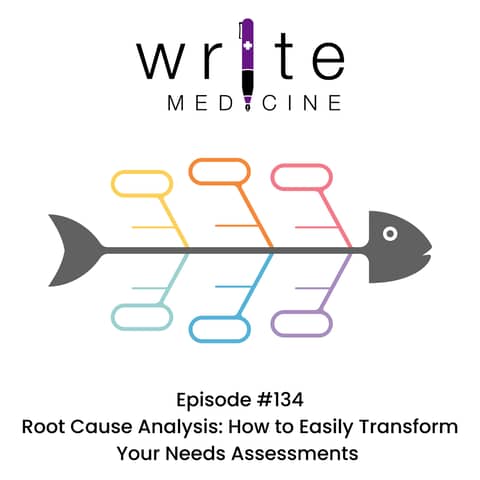
So what are the nuts and bolts of actually doing a root cause analysis? There are different tools that you can use. One that you're probably familiar with is the Fishbone, also known as an Ishikawa Diagram. This is a visual tool that helps you organize and analyze contributing factors in categories like people, processes, equipment, materials, environment and management. You can create your own categories but the key here is that the fishbone is a very visual tool that helps you to map relationships between these different factors. Another approach is the five whys technique which involves asking why repeatedly for at least five times to drill down to the underlying causes of a problem.
So for instance if you identify a problem with medication errors, you might ask why the errors are occurring and then ask why again for each answer until you've identified the root cause.
Maybe those errors are happening because the nurses are overworked and distracted or perhaps the medication labels are confusing. Or, plot twist, what if the hospital's digital system is glitchy? So we keep asking this why question until we get to an answer that we can actually target with education in a very specific way.
And finally, Pareto analysis is a statistical method that can help you identify the most significant factors contributing to the disease. A gap or a problem. And this can be especially helpful when you're dealing with a complex issue that has many potential contributing 📍 factors.
So we've covered a lot, but I'm not going to leave you hanging.
Actionable Steps and Resources
Here are some very actionable steps you can take right now. First, identify an upcoming needs assessment project where you can apply root cause analysis. Second, Gather your dream team. Diversity of perspective on the problem and its potential causes is key here.
You want as many different ways of thinking about what this root cause might be. as possible. Third, try out some root cause analysis tools. I like the fishbone diagram, it's cooler than it sounds, I promise, and the five whys technique. They're simple and fairly easy to apply. You can follow the steps I outlined earlier to conduct your root cause analysis.
And I'll make sure to put some links in the show notes to provide a little more detail for all of the methods that I've described. If you want to learn more about root cause analysis and how to apply it in your work, there are tons of great resources available.
The Institute for Healthcare Improvement offers a free online course on root cause analysis, and the Agency for Healthcare Research and Quality has a comprehensive guide to using root cause analysis to improve. patient safety, but it's applicable in lots of different areas. And I'll pop the links into the show notes.
Conclusion and Final Thoughts
So there you have it. Root cause analysis is a powerful tool for identifying the underlying causes of practice and performance gaps and developing targeted By incorporating root cause analysis into your CME needs assessment process, you can create more effective and efficient interventions that drive real improvements in health care quality and patient outcomes.
Overall, incorporating root cause analysis into the CME Needs assessment process builds a more comprehensive understanding of the underlying causes of suboptimal patient outcomes or healthcare delivery issues, helping you develop targeted interventions to improve healthcare quality and patient safety.
So I encourage you to start applying the concepts we've talked about today in your own work, whether you are an education strategist, planner,
grant strategist or writer. Remember, the key steps are defining the problem, collecting data. Identifying contributing factors, analyzing the data and developing and implementing solutions and with practice and persistence root cause analysis with any of the techniques that we've talked about Fishbone, FiveWise, Pareto can become a very valuable addition to your CME toolkit.
That's all for today's episode of Write Medicine. Be sure to subscribe to the podcast for more insights and strategies on creating effective CME content. And if you have questions or suggestions for future episodes, don't hesitate to reach out. You can leave a voicemail on the podcast episode Or connect with me on LinkedIn.
Until next time, keep writing and keep making a difference in healthcare education.


